Click on the title of this post to read it and see a related header image.
I worked in the computer industry for too long, in a variety capacities.
Most every year I would head to San Francisco to the MacWorld trade show to learn of the latest gadgets my customers might want.
The last year I attended as my interest in the technology sector continued to wane, I witnessed something that I think is at the heart of what happened last week in a small school back east.
As I walked the many aisles of Moscone Hall visiting vendors, I was stopped by a horde of people that had spilled out into the aisle from within one company’s display area, or “booth”. Unable to easily walk through the densely packed, all male road-block, I stopped to see what they were all looking at.
Besides the throng of men and boys of all ages staring towards the presenter, the overwhelming sense was the very loud sound of gunshots and squealing tires.
The company was selling video games. First-person-shooter video games that enable the “player” to assume the role of an assassin and venture out into the virtual world created within the confines of the flat screen, and shoot people.
As the assistant was effortlessly blasting, running, blasting and reloading a variety of weapons, the speaker was extolling the virtues of this new version of a very popular game.
This new version had a faster processor, more memory, more weapons and a brand new graphics engine. This graphics engine could render scenes quicker and so realisticly he said, you’d be pulled right into the environment and forget where you were.
The line that sticks with me to this day, as his assistant, the assassin, shot person after person on-screen, the line that reverberated in my mind today as I watched coho spawning, coho soon to be dead after using their last bit of energy to create and deposit the next generation of a species likely to soon go extinct in California, delivered with such pride and enthusiasm, you’d have thought he was explaining a cure for cancer, so proud of his new and improved graphics engine – “Look at that blood! It’s so realistic.”
If you have children, please regularly spend time with them away from anything that requires electricity or batteries or has a screen.
And now that you have read this, turn off your computer, send some love, strength and compassion to those grieving families back east, hug your children and take them outside somewhere to look at the stars, smell a damp bay tree, listen to a free flowing river, or a croaking frog or the wings of an owl overhead.
Click on the title of this post to read it and see a related header image.
Click on an image for a larger, sharper version.
I went for a short walk on this beach this evening, thinking of those families grieving their losses. I can think of no greater pain that that of losing a child.
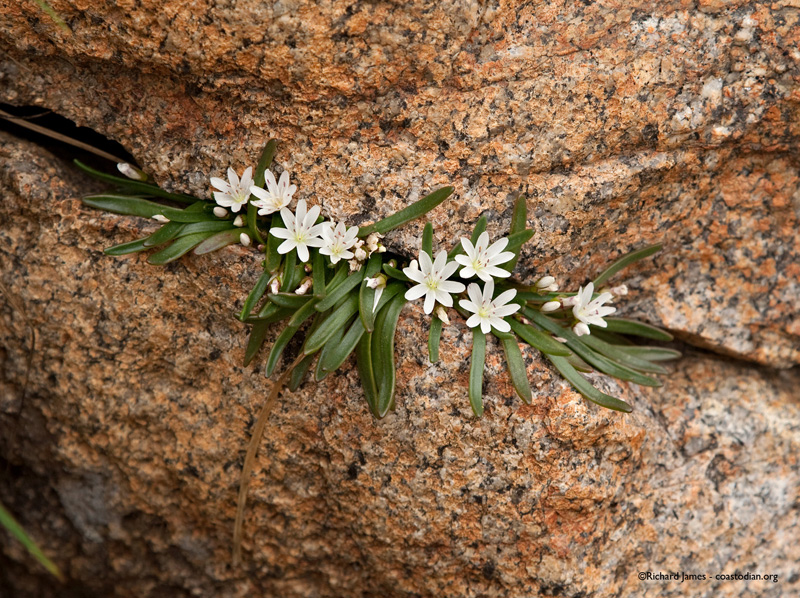
Beauty ushers forth from between a rock and a hard place. Lewisia is one of my favorite flowers of the sierra. Found up high where few dare visit.
Even when the landscape is stark, beauty can be found. In the foreground is Polemonium, also known as sky pilot, the name given to a chaplain in the military. It is one of my favorite flowers of the sierra, found only in the highest of places where bighorn sheep, eagles, pika and fools roam free.
May the families in pain tonight find solace in the beauty of nature while we all share in their sorrow.
Click on the title of this post to read it and see a related header image.
13 December was the highest tide of the year and I was out recording it.
NOAA predicted that a 6.58 foot tide would reach Inverness at 11:13am.
Below you will see a 5 3/4 minute video I shot at 6 different locations along Tomales Bay from Chicken Ranch Beach south to the Inverness Store.
While not as exciting as watching endangered coho salmon spawning (see that here), these high tides are, or should be a very sobering event for us all.
If the earth continues responding to humans as it has been, the ocean will continue to rise and what you see on the video will be the normal everyday tide in just a few years.
As I setup my equipment and recorded I spoke with several people, mentioning the king tide and how this was to be the new normal in a few years. Virtually no one I spoke with had any idea of this. Some of these people have homes on the shore, or over (under) the water.
PLEASE NOTE: All of the images and video on this website are copyrighted works, belonging to Richard James. If you do not have explicit permission to use them from Richard James, do NOT use them. Please ask me about licensing them.
Near kayak rental and The Golden Hinde 38.107713° N -122.863002° W WGS84
Near the Inverness Yacht Club – I wonder if that building has a bilge pump? 38.103156° N -122.857720° W WGS84
Near the dacha, the owner was there and had no boots. He waited til after noon to gain access 38.101382° N -122.856399° W WGS84
Launch for hire, aka The boat house 38.100113° N -122.854925° W WGS84
Behind Inverness Store 38.097681° N -122.850816° W WGS84
Get your water-wings on and enjoy. Mostly it is rather quiet, the clip at the store has loud sirens in the background, so watch your volume.
If you have high speed internet, click the full screen icon at lower right, this is HD video.
If you do not have high speed internet, watch it small or go for a long walk while the video loads.
Fish that were eggs three years ago are now returning to lay eggs, usually in the very same creek they themselves hatched in. Once this task is done, the fish will linger until they die. This could be a few days or a couple weeks depending on the condition of the fish, the presence of predators as well as water levels.
Female coho carry about three thousand eggs. If 2 percent make it to adulthood and spawn 3 years from now, that is considered a huge success.
The ten minute video you can watch below was shot on Lagunitas Creek near the Leo Cronin viewing pools in Samuel Taylor Park. I apologize for the intrusive title. I must be doing something right as my work is being used without my permission more and more. Marking it ensures I am credited for my efforts. If you’d like to license my work for your use, contact me at info@coastodian.org. Financial support allows me to continue documenting our natural world and hopefully galvanize mindful action to protect it from us.
If you want to see spawning salmon in person, now is the time.
For the best chance at seeing fish here are some tips:
1) Quiet. Keep voices down, the fish can hear you and will spook off their redds (nests) if you are too loud.
2) Dress in neutral or darker colors, nothing flashy or bright, they can see you too.
3) Be still. Lots of movement will also scare them off the redd.
4) Bring polarized sun-glasses to cut the glare on the water. Binoculars are good too.
5) Leave pets at home. Barking dogs and lots of movement distracts fish from this most important task
6) Ideally, view fish from just downstream if you can, that way they are less likely to see you and your time to view them will be greater.
Click the full screen icon in the lower right corner of the video window and spend some time in nature.
Click on the title of this post to read it and see a related header image.
Having previously hidden in the bushes a rather heavy and valuable item I dug out of the sand, a quick visit to Drakes was in order. Little did I know, in addition to recovering my treasure, I’d see another amazing moment involving birds in their natural environment, this was a top ten event for life. Maybe top fifteen.
Hustling down Drakes Beach, it was mostly as I’d left it two days prior, though now I was picking up many items I had skipped before. There is just too much trash on the beach for one person.
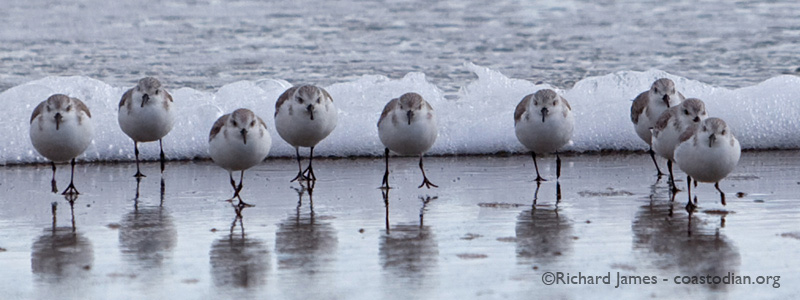
Two hundred meters into my journey I noticed a large flock of sanderlings and maybe a few western sandpipers were probing for invertebrates near the water. Two or three hundred birds scattered across fifty meters of shore, all pecking and moving, looking for food as the water lapped at the hard-packed fine sand. Suddenly, from the west the birds started to lift straight up. Though not the usual dance, where those at the back of a bunch fly over to become the birds at the front of the bunch, to get first tracks on new ground. This was a more chaotic movement, they were all moving in different directions, quickly.
For a moment I wondered why, then I saw it, dropping out of the sky from maybe a hundred feet up. Sharp, stout, pointed wings. Black mark through each eye. Wow I thought! A peregrine is making a high speed run through this flock of snacks. Many times I had found the remnants of one of these events on the beach. A pile of feathers. Once, while out with the Point Reyes plover person, we saw a peregrine sitting on a log, snacking on a recent kill. As we walked closer, it flew off with the body of a small bird clutched in its’ talons. We walked over to the log it had been on to find bright red blood dripping down the log and an even brighter red heart the size of a chick-pea, still glistening, having just been torn from the chest of this tiny shorebird. What A shame to leave the heart I thought. My grandmother always savored the heart, liver and kidneys from any deer that had been killed.
The falcon dropped fast, exchanging altitude for speed. As the peeps rose up and tried to steer clear, the falcon, now going 50-60 mph was 3 feet off the beach and looking to make contact. Again and again it dropped one wing, then the other, turning left and right. Instead of colliding, and killing, it was more like a slalom skier, passing gates, never catching a tip, always a fraction of an inch from striking.
Shorebirds continued to lift and scatter down the line from west to east as fans would raise arms in a wave at a football stadium. Wanting so to see skier impact a gate followed by an explosion of feathers, I was disappointed, but only a tiny bit as the falcon passed the end of the line of gates. A perfect ski run. A big fat zero in the dinner department. Over in 3 seconds. It flapped 5 or 6 times and shot back up into the sky.
The sanderlings and others headed out to sea. The falcon pulled a tight turn and flew back over me looking for stragglers, finding none it flapped off into the setting sun.
I must have said wow twenty times, replaying what I’d just witnessed as I walked another three hundred meters to see if my treasure was where I’d left it.
Click on the title of this post to read it and see a related header image.
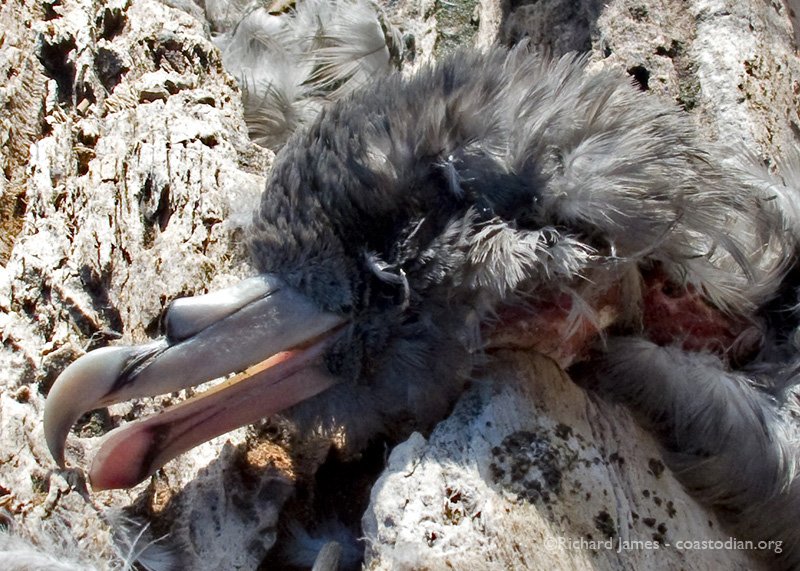
When alive and living on the open sea as pelagic birds do, this fulmar, a member of the order Procellariiformes, drank salt water then ejected the salt from the extra feature atop its’ bill. These birds are known as tube noses.
Now that it has died, the flesh that once flexed wings is in the belly of a turkey vutlure most likely.
Click on the title of this post to read it and see a related header image.
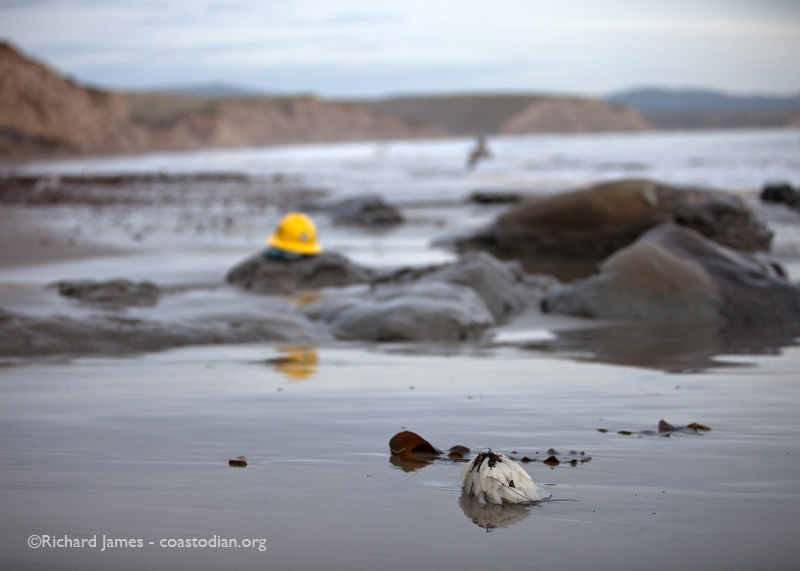
Since the high litter season is upon us, I am out on Drakes gathering the man-made debris washing in with the strong southern winds of late.
Near to where the northern fur seal found me just over a week ago (turns out it is a female and very feisty as well as still alive), I came around a corner just as a juvenile red-tailed hawk lifted off the sand with an injured, but still very alive northern fulmar. It was slowly climbing and headed straight towards me with the struggling pelagic payload in its’ talons.
I dropped down to the ground to cut a smaller profile as I watched the hawk flapping and flapping, yet gaining altitude like an overloaded Bonanza at noon in august at Truckee. That is, it had a positive rate of climb, barely.
The fulmar was flapping and struggling under the hawk which probably did not help matters much.
As the pair was about to be overhead and about 70-80 feet up, the hawk jettisoned the fulmar and floated upwards with ease. The fulmar dropped like, well, a rock. SPLATT! Onto the hard sand with about 1 inch of water. The dazed bird looked around, not sure if this was better than being pierced by talons and flown away to be eaten.
I sat crouching for a couple minutes to see if the hawk planned to return and try again. It did circle us a few times but eventually flew off to find a smaller bird.
After walking east a few hundred meters and picking up oyster spacer tubes and tampon applicators by the dozens, I turned around and found the floundering fulmar being swept back and forth in a slowly rising tide. I dropped my bags of plastic and went over to see if I could move it to a less hectic place. Even after all it had been through, this bird was very capable of defending itself. I barely was able to grasp its’ wings and keep my hands away from the sharp end trying to peck me. I carried it up to where a pile of logs had been pushed up against the wall and laid it in a protected spot in which to die without the tide and raptors interrupting.
I wonder what that crab fisherman was expecting to attract with a bait bag full of tampon applicators?
Squid egg masses
I learned today from the folks at The California Academy of Science that these egg masses are likely from the Common Market Squid (Doryteuthis opalescens)
Still tired of all the man-made debris washing up.
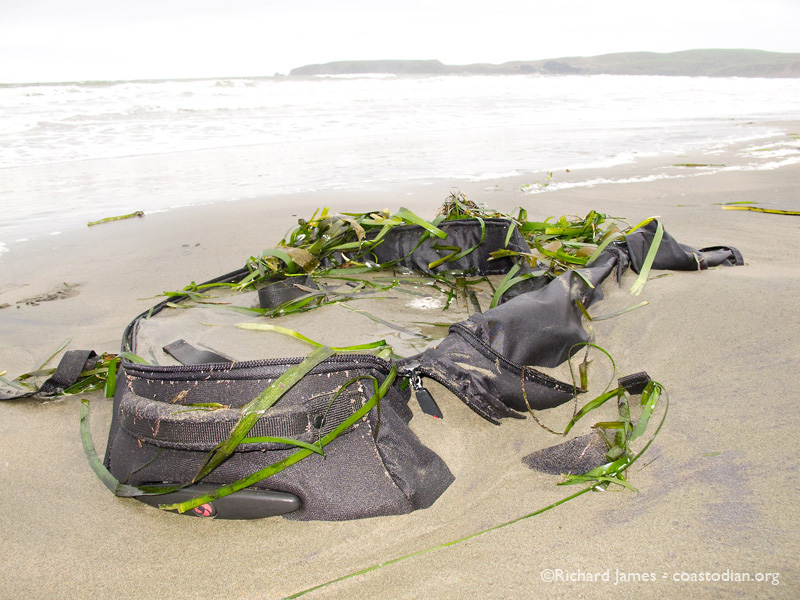
Did they pack all that sand and eel grass? Was Drakes Beach their final destination?
Marc from France – A photographer touring California for the first time. He has two small children back home and was happy to find a frisbee for them. I gave him the football I had just found for his 9 year old son Isaac. Marc was in love with the light and the Point Reyes area. I offered some travel tips for his next 12 days.
Click on the title of this post to read it and see a related header image.
13 Dec 7:40pm – I just got word that the fur seal known as Sparkle has died. She was just too small and undernourished to make it.
I just read that the sex of the seal has been determined, female.
NOTE: I was at an art opening at The Marine Mammal Center tonight (29 Nov) and learned a little more about this fur seal. It weighed a diminutive 4.5 Kg, the tiniest of the 7 fur seals they have presently. In addition to being severely underweight (below birth-weight), it is also very dehydrated and likely has pneumonia. There is a good chance it will not survive.
Big storms are happening in California which means litter season has begun.
I went out to walk along Drakes Beach this afternoon to see what the strong southerly winds had pushed ashore.
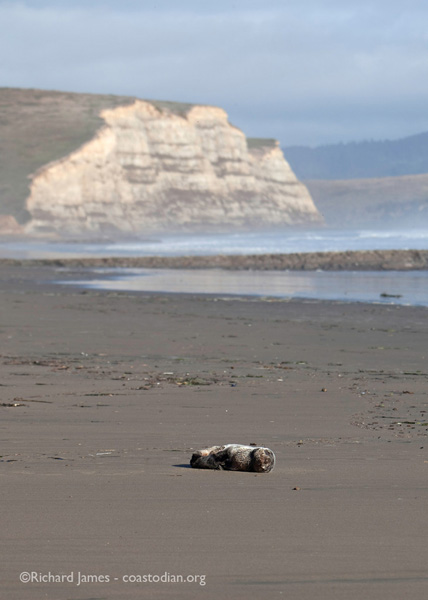
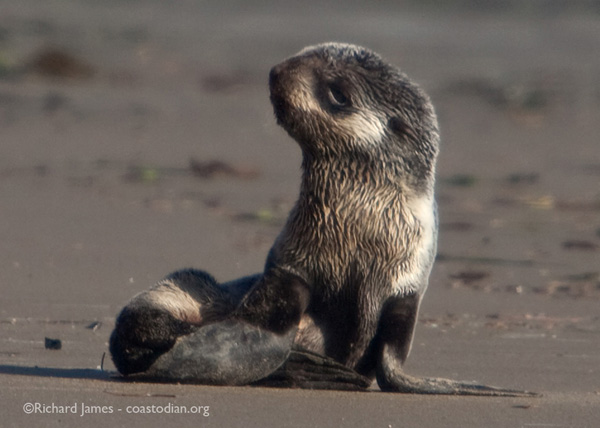
While walking back to the car, this little one hauled out right in front of me.
Emaciated Northern Fur Seal pup (Callorhinus ursinus)
As tired and emaciated as it was, I surely looked too much like a predator, so back in to the roiling surf it went.
I kept walking back to the car and watched as it hauled out again and scooched back in the surf again and again and again.
Quickening my pace so it might haul out behind me and feel safe enough to stay, I stepped over kelp, logs and foam, careful not to trip. Thankfully it did haul out again and headed for high ground.
I only had a point and shoot camera, so I stayed a good distance away and watched as it shivered and groomed. It was exhausted and I imagined happy to be out of the pounding surf.
Over the past few years I have packed out the dessicated bodies of two dead Northern Fur Seal pups (and one Guadalupe Fur Seal). This was the first live specimen I had ever seen. I really wanted good images, but my main camera was an hour away.
NOTE: I am on the collecting permit of the California Academy of Science. Because of this, I periodically recover birds or marine mammals deemed of interest to the Cal Academy. Please do not remove animals from the beach, ever. If you see a live or dead seal, note the location (GPS waypoint is best), size, species if you know it, condition and call the dead animal hotline at Cal Academy (415-379-5381) if the animal is dead. If it is alive, call the Marine Mammal Center stranded animal line at (415-289-7325). Never pick-up a pup that is alone. It is likely the mother is away feeding.
Scooping up the piles of plastic I had cached on my walk out, I hurried back to the car for the drive back to get my long lens and fast camera.
An hour later I was back with 400mm of lens and tripod to allow me enough distance so as not to worry the animal as I ogled with my binocs and clicked the shutter. It had moved out into the center of the beach, perhaps the falling rocks from the cliff above made it think twice about being so close to the cliff. The dropping tide created a vast, flat and mostly dry place to curl up.
As I maneuvered and fiddled with my tripod, microphone and other equipment and shot images, others took an interest in this furry bundle of protein sleeping on the beach. A vulture floated by and peered down. A raven swooped overhead and lit on the cliff over us, wondering if this morsel was ready to consume. A very large gull sauntered up quite close, I thought I might be able to record an interesting exchange as they got to know one another. But the gull looked at me and backed off. It did not know that I eschew gull.
Not the best image, but it does show nicely how to distinguish a Northern from a Guadalupe fur seal. The fur on the fore-flipper of a NFS stops far from the tip, as you see here. The fur on a Guadalupe continues down about half way to the end and has a less straight line where it ends, more ragged.
After an hour or so of watching and clicking, I packed up and headed back home.
On the way back, a few phone calls later, after they concluded that I did indeed know the difference between a California sea lion and a fur seal, a person from The Marine Mammal Center was on his way out to recover it.
He was going to arrive after dark and his flashlight was not working. I offered to come along and show him where it was and I had several bright lights. He was happy to have me join him.
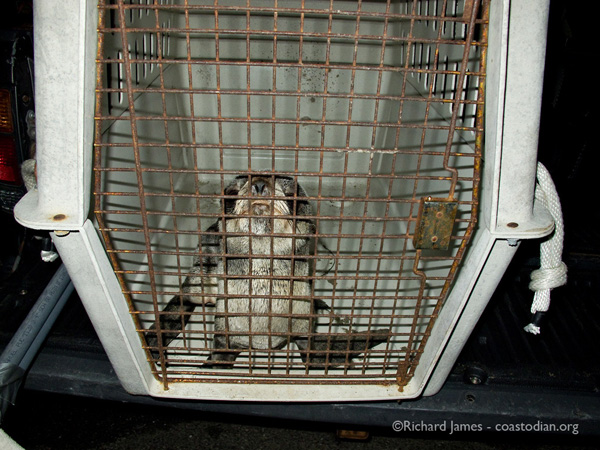
After parking, we carried a small dog carrier with us as I lit the way on our walk to where the seal was last seen. We were on it much sooner that expected as it had moved a 100 meters or so. We dropped the carrier and Doug set off towards the rapidly fleeing seal. Up close it it was even smaller than it appeared while I photographed it.
Doug estimated it to weigh about 5 kilograms and to be about 2 months old. It was clearly emaciated, though still rather feisty.
Into the carrier it went and we carried it back to the truck.
Sparkle, as this seal has been dubbed is likely just arriving at The Marine Mammal Center as I type this. It will immediately be fed via a tube the equivalent of Pedialyte to rehydrate it. Tomorrow it will be looked over by a veterinarian. Go here to see a list of all the animals currently being cared for at the Marine Mammal Center
If it recovers enough weight and is otherwise healthy, it will eventually be released to hopefully live a long and productive life.
Here is a a 3 minute video of my visit today with a Northern Fur Seal. My apologies for the intrusive banner across the bottom. I hope to at least be recognized as the person producing the images and videos when they show up all over the internet and in classrooms.