Gray sky, gray whales

Click on the title of this post to read it and see a related header image.

This morning at 7, following a tip heard by me during restless sleep last night I made my way to McClures Beach.

My wipers slapped the condensed gray of the sky off my windshield as I drove north to see what was meant for me.

Crawling indelicately across the mussel and algae covered rocks protecting the north end of the cove between Elephant Rock and McClures Beach, oystercatchers announced my ungainly presence to the pelicans diving for breakfast and the cormorants filing past in long lines.

Not 150 feet offshore, two mottled gray, scar-covered backs broke the surface, one large, one small, attached at their waists it seemed, loud gasps announced their meeting the surface. Effortlessly they slid beneath the swell-less sea.

Again and again for 45 minutes I watched as they rose and dove in search of breakfast. I imagine a dozen or more, some far out, at least three, a cow-calf pair and a third made it to within 100 feet of me as I sat on the rocks enjoying this treat playing out before me.

Not once did I see any wrappers, cups or plastic bits usher forth as they devoured their morning meal.

I thought I heard one say to the other as they eyed me onshore, “See, there’s one of them. They think they’re so clever.”

These animals have more sense in one fluke than do 6 billion humans and all the smart-phones to ever be built.

Not me, I know I’m as dumb as a very big bag of plastic bottles.

Bottled water stinks

Click on the title of this post to read it and see a related header image.

Bottled water stinks


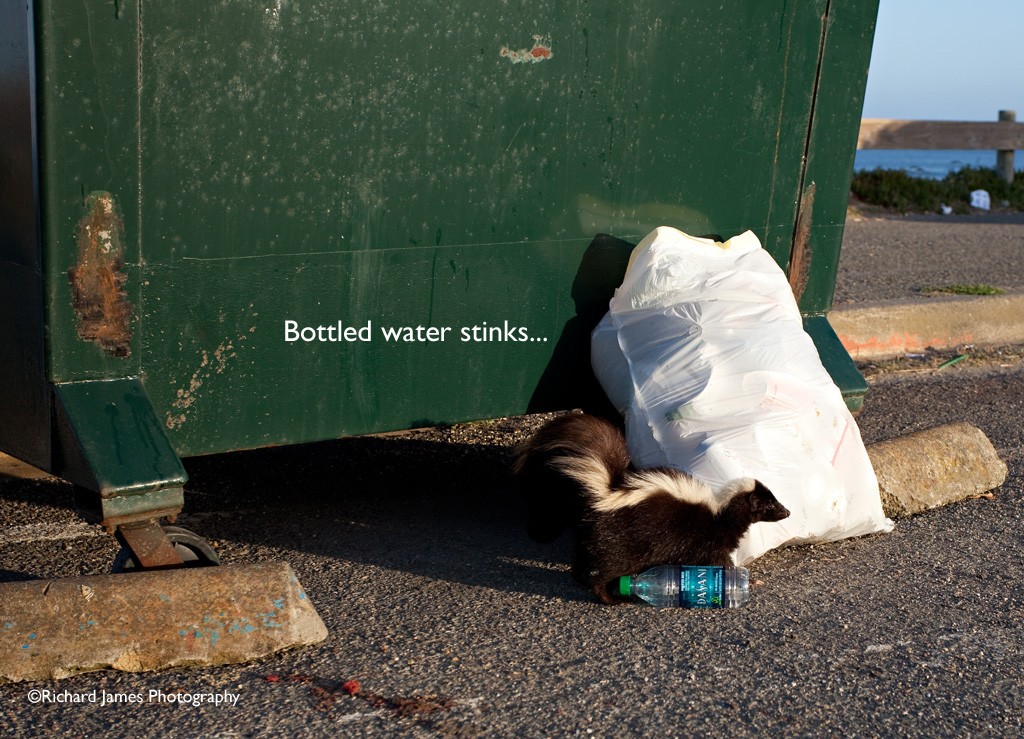
In 2011 on the 4th of July, the NPS forgot to place a second dumpster at Drakes Beach, something I was later told is the norm. The masses and their hundreds of recyclable beverage containers, BBQ scraps, oyster shells and broken furniture/plastic toys overfilled the lone dumpster. This skunk chewed into the plastic bag you see and scattered debris far and wide. I spent a couple hours picking up after the skunk as well as the wind that had distributed all the items that did not fit into the lone dumpster.

Below is a short clip of one of the many visitors to the beach each morning, looking for a bite to eat. Notice this animal does not leave any wrappers or other trash after dining.

https://youtu.be/AAvZwQzGb6U

A long walk on The Great Ocean Beach – Point Reyes

I’ve not posted anything in a while.

My creative muse is on extended hiatus and my writing is not something I am overly fond of.

Last night the swell off Point Reyes was over 20 feet for an extended period of time, peaking at nearly 25 feet around 3:00 am. Big waves! Big fun.

I love being on the beach when the energy is high.

Last year I walked nearly the entire Great Ocean Beach with a few friends. We got a late start and grew tired, so we did not do the last mile.

Yesterday I decided to bag the whole enchilada. I packed food and drink, and all the clothes I might need. Without a car shuttle, I either needed to hitch a ride at the other end or do the walk twice. How would my legs hold out?

The blue line is my track - click to see a larger image

Got up at 5:00 am, drove to North Beach (the midpoint of the Great Ocean Beach, some call it ten mile beach, others twelve mile beach, I call it the outside beach, Drake/Limantour being inside) and stashed two liters of water. Then I drove up to Kehoe Beach and left the car at 6:19 am. After the short walk to the beach I was greeted with moderate winds and huge seas. The foam was deep and all the way up to the dune grass. Enormous waves crashed and pounded the beach.
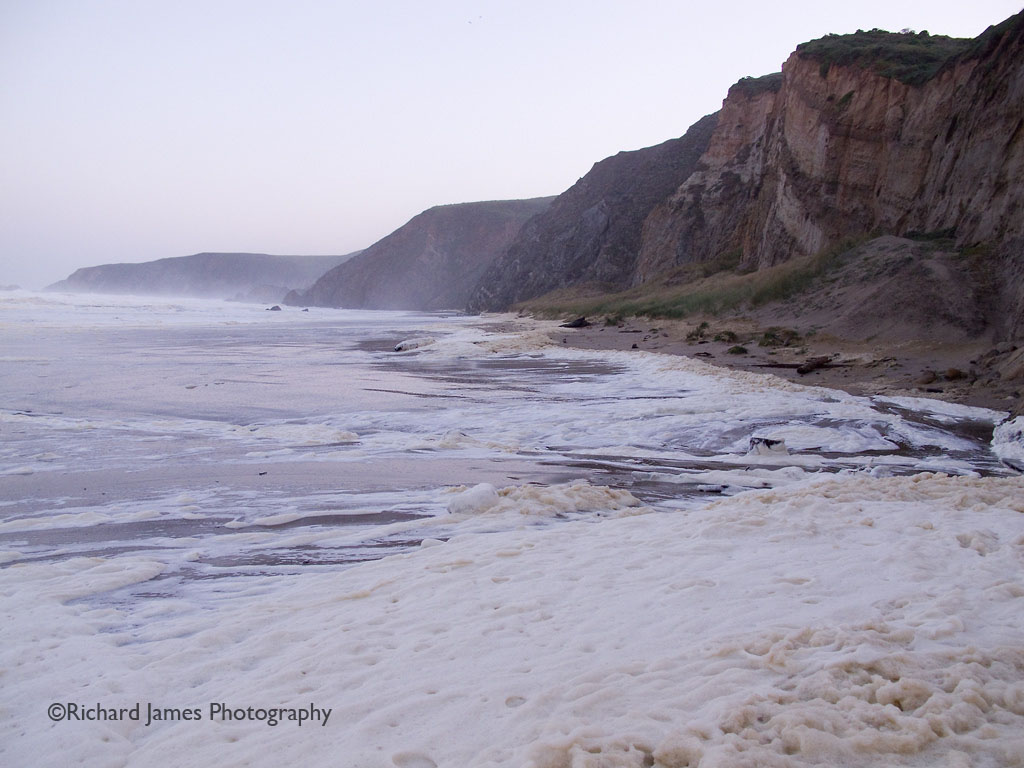
To do the whole beach proper, I hiked north about two thirds of a mile to the wall. I had to dodge waves and deep drifts of thick foam all the way to the wall. Sea birds, wounded in the heavy surf littered the beach or swam in the foam/water, clearly not well. At the wall I set a waypoint and set off to the wall at the other end by the Lighthouse. It was 6:49 am.

All along the way I was serenaded with the sound and sight of enormous crashing waves. Waves twenty feet high crash long and loud, foamy spray shooting into the sky. The litter load was not as heavy as I would have thought. Lots of crab gear, some pelagic litter (from far away, coated with goose-necked barnacles and green slime) and the usual wrappers, bottles and broken patio furniture. One glass IV bottle showed up with Asian writing. As did a small brown glass vial for needle use. Only one hypodermic needle today.

Given my need for speed, I did not pick up everything in sight as is my usual MO. Plastic bottles, tennis balls, oyster spacer tubes, plastic brims from sports caps and the random toy made it into my several bags.

At one point I almost tripped over a Western Grebe. It immediately began kicking with one leg and crying out. The other leg was lifeless. I backed off a bit til it quieted down and watched it for a few minutes. It was terrified, unable to move except in a semi-circle as it kicked with one leg and cried. I pulled out my knife, said a short prayer, looked it in the eye and put it down.

Still miles from the other wall, I moved out, the lifeless, yet I hoped no longer suffering grebe foremost in my mind.

As I neared the North Beach parking lot, I noticed the heavy surf had knocked down a large portion of the rope fence put up to keep people out of Western Snowy Plover nesting areas. Walking along and resetting several posts, I hoped I had set it in the same location it was before.

By now I had about 35-40 pounds of trash with me, time to cache this and get some water and snack. One apple, some cheese and chocolate washed down with a liter of water and I was good to go.

Eventually I reached the South Wall at 1:07 pm and stopped for lunch. Legs sore and now facing a headwind, the idea of punting at either South Beach or North Beach on the way back crept into my fatigued mind. My third apple, 2 more ounces of cheese and some chocolate consumed, I set off into the quartering-headwind from whence I came.

By the time I reached North Beach again, my legs and feet held the floor and the vote was in, punt. Climbing over the bank, the parking lot was full of cars, surely one was headed to Kehoe eventually.

The nearest car’s driver had just hopped in and turned the key. I caught his eye and got him to roll his window down. “Hi, are you by chance headed to Kehoe Beach?” I asked.

“Well, I am making it up as I go today, where is Kehoe?”

“About twenty minutes north of here, I’ll show you the way and explain the sights as we go.”

“Great, hop on in.”

Daniel was visiting from the East Bay for the day, exploring beaches he had not visited in many years. He drove me right to my car. I and my feet thanked him profusely and we parted ways.

I popped three more ibuprofen and headed back to pickup the trash I had cached at both North and South beaches. I still have another cache to pickup further south and will do that later.

After 20.85 miles in soft, sloping sand, the hot shower felt wonderful.

Stinson Beach Library – Found Art

Four artists’ work is on display at the Stinson Beach Library until 31 January, 2012.

Richard James has two of his large meta-bottles on the patio along with 49 jellyfish I made out of Korean fishing-net floats and crab-fishing rope.

Lina Jane Prairie has baskets made from kelp and the same rope I use for tentacles.

John Norton is showing a few of his collections of similar items found on the beach.

Tess Felix has created two mermaids and a few portraits, mosaics actually, all from the bits of petroleum-based plastic we humans discard every minute of every day which wash ashore on the world’s beaches and are eaten by birds and fish the world over every minute of every day.

Orca at Point Reyes

Click on the title of this post to read it and see a related header image.

NOTE2: Go to this post to see images of the skeleton being assembled at The Academy of Science.

NOTE: Hello orca enthusiast. You’ve found my images, take a moment to leave a comment at the bottom of this page. Tell me how you got here, what your interest in orcas is. This orca skeleton is being assembled at the California Academy of Science for the next few weeks. Go here to learn more.

I packed out both pectoral fins as well as four vertebrae.

Here are images from the removal of O319 from the beach.

[nggallery id=3]

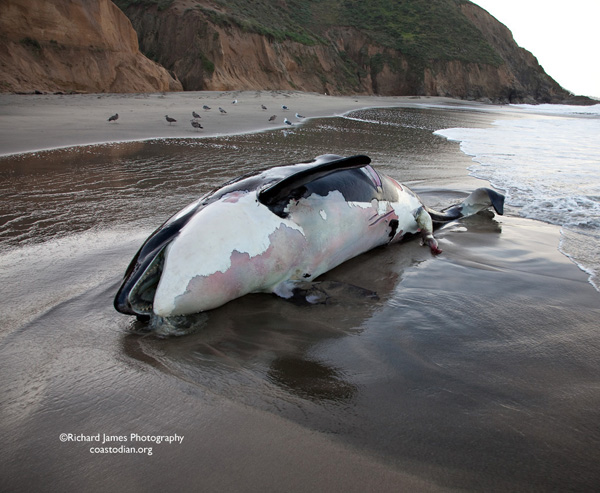
An 18 foot long, juvenile male orca washed ashore on a remote beach at Point Reyes just before thanksgiving 2011. This animal belongs to one of three ecotypes, the offshore group. It was last seen off Vancouver in September. The other ecotypes are resident and transient. These names are derived based on what the animals do during the summer months.

A full necropsy was performed. Blood was found in the blowhole and there was other evidence of trauma to the head. This may have been the result of being struck by a ship, or during interactions with other whales. No determination on cause of death has been made.

Little is known about offshore orcas. This may be only the second specimen of this type to be collected, most animals die offshore and sink.

Orcas are actually members of the dolphin family, the largest member. Males can grow to over 30 feet long, though are usually 20-26 feet in length. This is the first killer whale known to wash ashore at Point Reyes in many decades.

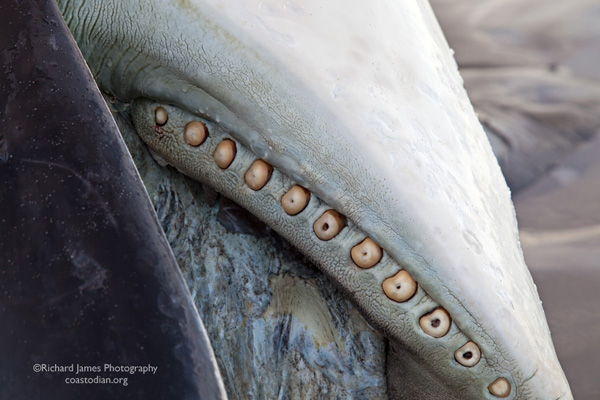
Offshore orcas mainly feed on sharks. Sharks have very tough skin and that is likely why the teeth of this animal are very degraded. Resident animals mainly feed on salmon, transients prefer marine mammals, such as seals.

Here is some video of the whale in the surf.

Orca – ©Richard James Photography

Orca – ©Richard James Photography

Orca flukes – ©Richard James Photography

Orca fluke – ©Richard James Photography

Orca mouth – ©Richard James Photography

Orca teeth – ©Richard James Photography

orca teeth closeup – ©Richard James Photography

Why is the sun yellow? – by Sethra May, guest blogger

Have you ever wondered why the sun is yellow? Or maybe why the sky is blue or the grass is green? Well, there are several ways to go about answering those questions. The sun, it’s yellow because it is a medium heat star. The sky, ya.. that’s blue because we’ve got this thing called an atmosphere and the blue you see is the light shining through the atmosphere. Now grass. If you didn’t know, you don’t actually ‘see’ things, what you see is the light reflecting off the object or person you are looking at. So, grass is green because the grass goes about absorbing all the colors but green.

So that was a very scientific way of answering three simple questions. Many parents would just tell their kids because it is. If I weren’t about answering this question, I think I’d say this: Because if they weren’t, the people on this world wouldn’t quite know what to do with themselves. So keep the world clean so that many years from now kids can continue to ask why the sun is yellow, the sky blue and the grass green.

Logging

This year the amount of plastic litter washing ashore is a fraction of that seen last year.

Storms, swells, wave and wind directions all conspire to return to land what we humans carelessly dumped directly, or indirectly into the sea.

I was invited by Jennifer Stock of the Cordell Bank National Marine Sanctuary to be on her radio show along with Curtis Ebbesmeyer, author of “FLOTSAMETRICS AND THE FLOATING WORLD: How One Man’s Obsession with Runaway Sneakers and Rubber Ducks Revolutionized Ocean Science”. Since 1990, Curtis has been studying the sea and how currents move the man-made trash constantly deposited in it.

Curtis told me that a current theory on the North-Pacific gyre is that it has an orbital period of about seven years and kind of wobbles around the large patch of garbage in the center of the gyre during that time.

Listen to Jennifer Stock interview Curtis on KWMR here.

You can read more about Curtis here

What is showing up in great numbers this year is lumber. Lots and lots of 8-foot long 2×4’s, 4×4’s and 4×6’s. Many of them as you’d find at Home Depot, a few are even straight.

I feel a bit like an ox, tilling the soil as I drag lumber down the beach. After some trial and error, making the rope just the right length keeps the leading edge from plowing too deeply as well as from smacking my feet.

https://youtu.be/wYxopqFsTUw

Nineteen is a prime number – too large and too small…

Last Saturday I walked 3 miles along Point Reyes Beach from North Beach to Abbotts Lagoon with the Point Reyes Plover expert. She does this regularly during Western Snowy Plover breeding season. She also covers other regions of the Point Reyes Snowy Plover breeding area. This day we were on the lookout for 5 Snowy Plover chicks that had hatched recently.

She prowled for birds while I gleaned the plastics that wash ashore on a regular basis.

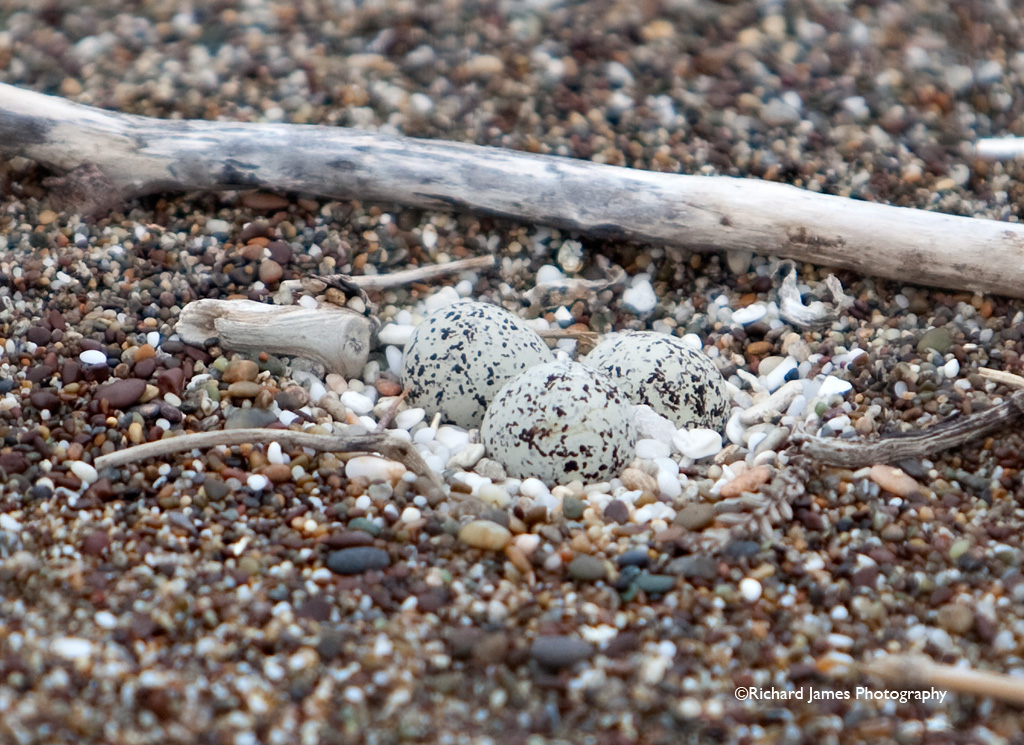
After creating a small depression in the sand and lining it with mostly light colored rocks to increase the stealthiness of the nest, a female plover will lay 2-4 eggs directly on the sand. Most times she lays 3 eggs.

Three Western Snowy Plover eggs in a scrape (nest)

About 28 days later, if the sea has not washed away the eggs, ravens, crows, coyotes, raccoons, skunks or weasels have not eaten the eggs, off-leash dogs or errant humans have not trampled the nest, the birds emerge form their cocoon. Plover chicks are “precocious”, meaning that they are out of the nest and cruising for food within hours after hatching.

Mother plover leaves to go find another mate, father plover begins a month-long odyssey attempting to ensure his brood learns to eat, and keeps from being eaten.

Researchers consider a chick fledged if it survives 28 days. The last 3 years at Point Reyes have seen 7, 8 and 5 chicks fledge (2010, 2009, 2008). There are an estimated 5000 plovers, period.

Western Snowy Plovers are on the endangered species list. This means that they are in danger of going extinct. Extinct means there are no more plovers. Ever.

Dog owners, please keep this in mind the next time you want to let your domesticated, far from extinct pal run off-leash in this area.

Beach driftwood architects, enjoy building your complex driftwood structures. But, once you are done, please dismantle your work-of-art. Ravens use these structures to rest and look for prey, including endangered plovers. Don’t make it easy for ravens to further reduce the dwindling numbers of snowy plovers.

The park plover expert knows when each plover egg is laid and when each chick hatches. Finding all plovers present and accounted for each day is a good day.

Last Saturday we found all 5 chicks, plus fourteen adults for a total of nineteen birds.

I found a small bag of plastic trash, including nineteen plastic beverage bottles.

Nineteen plastic bottles, nineteen too many

So, depending on one’s perspective, nineteen is too small, and too large.

Please use one metal bottle for your drinking water needs.

The coastodian

Three is a good number

Click on the title of this post to read it and see a related header image.

Sometimes I come across much more pleasant sights than a beach covered with plastic.

Here are three peregrine falcons on Kehoe Beach. The middle bird is a chick that has fledged.

Three peregrines

Three peregrines, one cleared for take-off

Three peregrines, one aloft

I imagine the other two are proud parents.

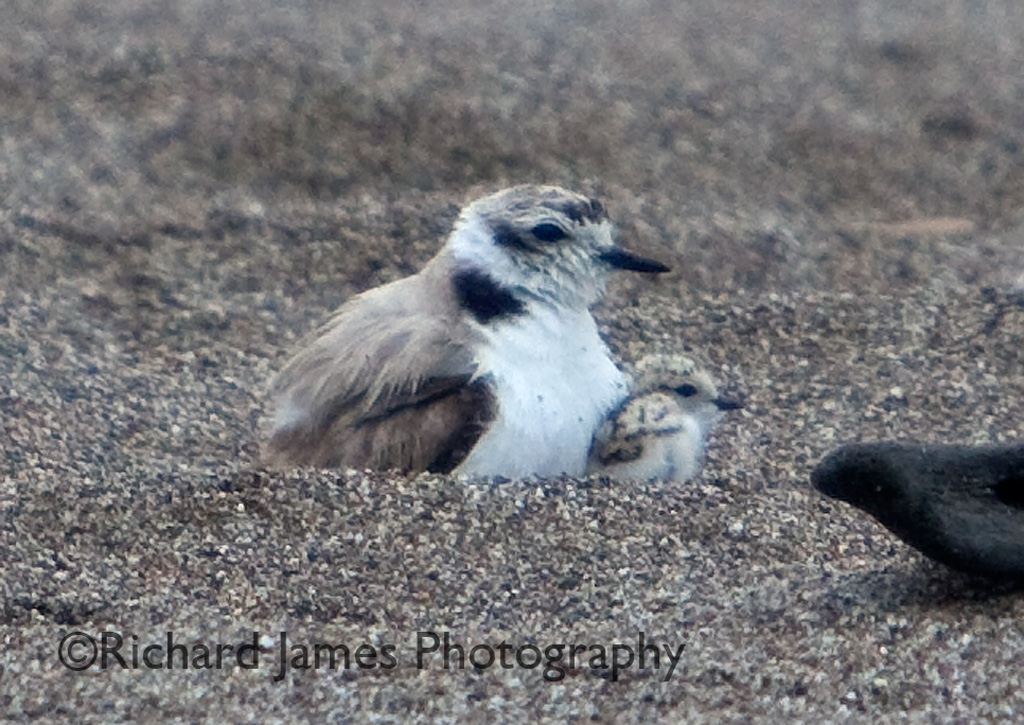
Here are the customary three chicks in a western snowy plover clutch on North Beach.

Three precocious plover chicks

Hagard plover dad and chicks

Happy father's day little plover


What I hope is a soon to be extinct plastic pink sea-horse.

If it has so little worth it can be left behind, as most of these cheap plastic toys are, why buy it in the first place?

WIth a little imagination, one can use sticks, kelp, and other natural items found on the beach to entertain a young child.

Sending money to China so petroleum can be turned into what will become poisonous trash makes no sense. To me at least.

I wonder if an iMagination app for the iphone is available?

coastodian

Powered by petroleum

Click on the title of this post to read it and see a related header image.

Powered by petroleum

Does my Prius consume more gasoline to go a mile than was needed to build and ship all those plastic bottles on the roof?

I don’t know.

Google could give me lots of numbers in a short time.

My eyes tell me that plastic bottles, even one, consume too much oil.

We kid ourselves, thinking it gets recycled, all is good.

If it gets recycled, why do I find thousands upon thousands of plastic water bottles on a fraction of the California coast each year?

What about all the animals that will eventually eat all that plastic we keep dumping in the ocean?

Man is one of those animals.

Tomorrow, instead of pouring milk on your cereal or in your coffee, eat the bottle.

Go direct!

Cut out the middleman and save.

Experience what all the fishes and birds in the sea do every day.

Or buy milk in a glass bottle.

Or raise chickens and trade their eggs for milk from your neighbor’s cow Rosie like a friend of mine does.

That bottle on my car is at Marin Arts Council for another month as part of their Pop Art show.

Check out the show here.

Go see lots of cool art. Buy a card and support the arts and your local coastodian.

Stop buying bottled water!

Get a metal water bottle and use your tap.

Put a filter on the tap if you don’t like the taste.

Stop fouling the rivers if you don’t want to filter that which belongs to our children, and their children, and so on.

the coastodian