Fishing is hard on the sea, living is hard on my heart

Click on the title of this post to read it and see a related header image.

The debris shown in the images below was collected after the first big storm of 2012 in early February.

Over two days I spent 10 hours and covered about three miles of Drakes Beach and South Beach. Just imagine what all the beaches of Point Reyes were covered with from just one storm!

The plan was to have posted these images in February. Due to painful distractions, I am finally getting around to sharing what I hope you find are compelling images. That is, I hope they compel you to give some thought to all that happens in order to bring seafood to your table.

Tomorrow is the commercial crab opener of 2012. Thousands of crab pots have been dropped in the sea attached to miles and miles of petroleum based rope, foam floats and plastic bait jars. Much of this gear will be lost due to storm, propeller strike or other activities. While scraping and grinding along the bottom of the sea, or abrading on the beach sand, many thousands of pounds of plastic will be pulverized and deposited into the food chain.

Does society have any idea what is undertaken to put seafood on their table? The time, expense and effort of the fishermen, the vast amount of gear lost at sea each season, or stolen by unscrupulous crab fishermen? A local fishermen once told me, after sharing with me the many ways in which fishermen “do unto others” in not such golden ways, “Crab fishing makes ya crabby!”

Be sure to have a look at the last picture. There you will get a close look at about 75 oyster spacer tubes from Drakes Bay Oyster Company (DBOC) in the foreground. I have found well over 5000 of these in the last five years. From as far north as the tip of Tomales Point and south to Slide Ranch.
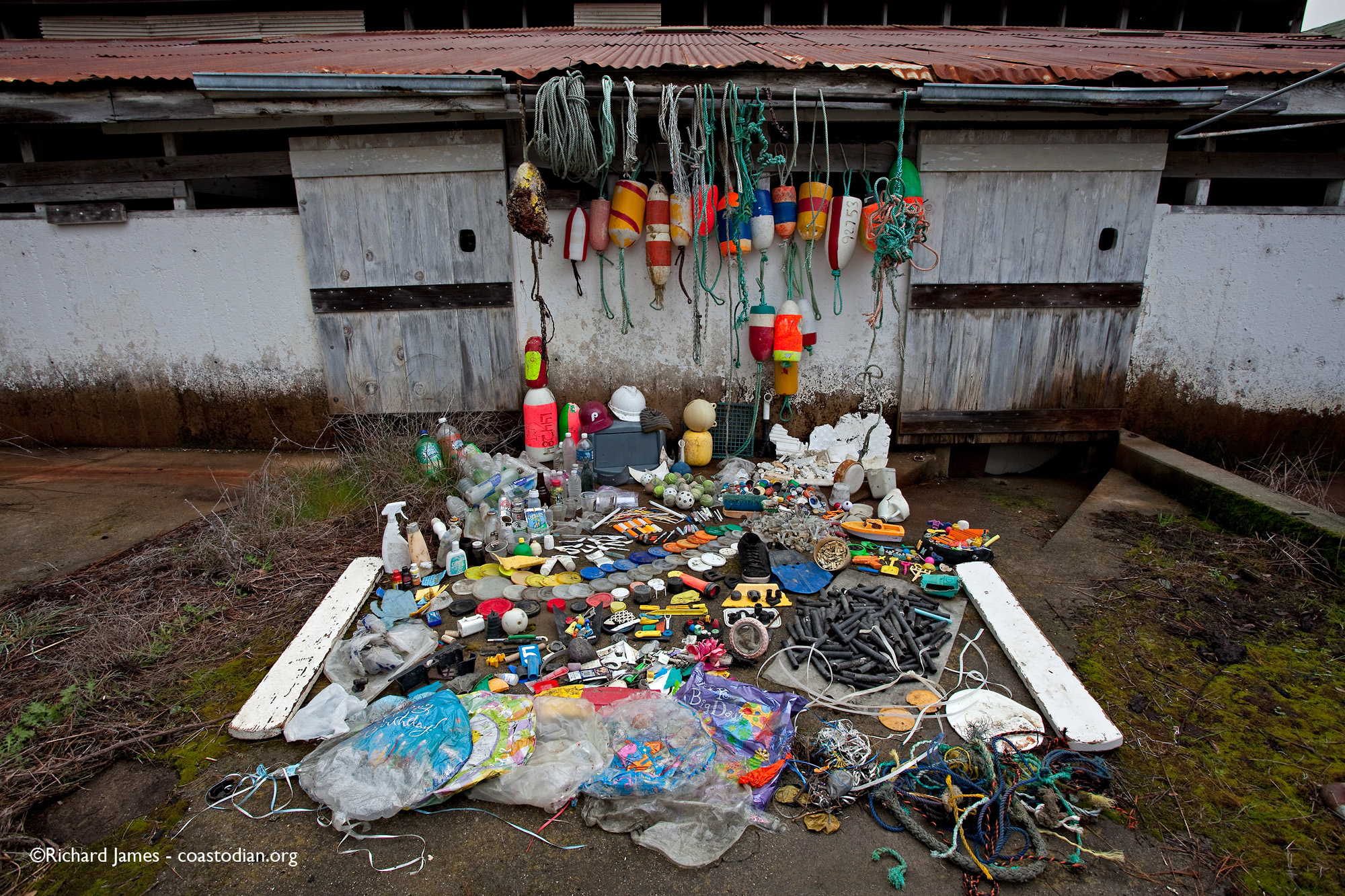
Click on image for bigger picture – Debris recovered over two days work, about ten hours effort

Click on image for bigger picture – Should the price of crab reflect the cost to the planet?

Click on image for bigger picture – Maybe some of this is yours?

Click on image for bigger picture

Click on image for bigger picture – Heroin, nicotine and caffeine….slower, faster, anywhere but here and now…
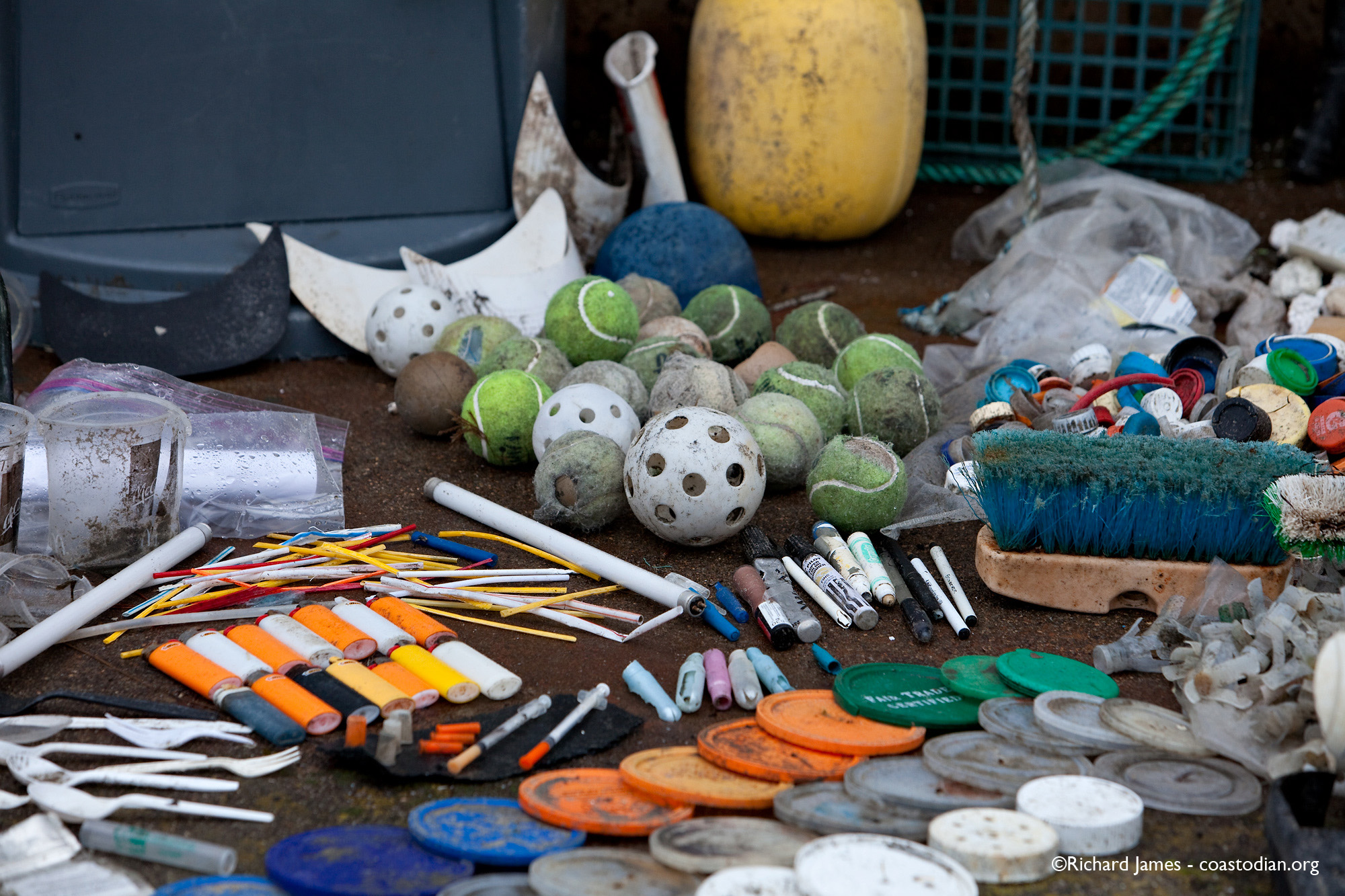
Click on image for bigger picture – If all dogs at the seashore are on leash….how come I find 100’s of tennis balls and ball tossers each year?

Click on image for bigger picture
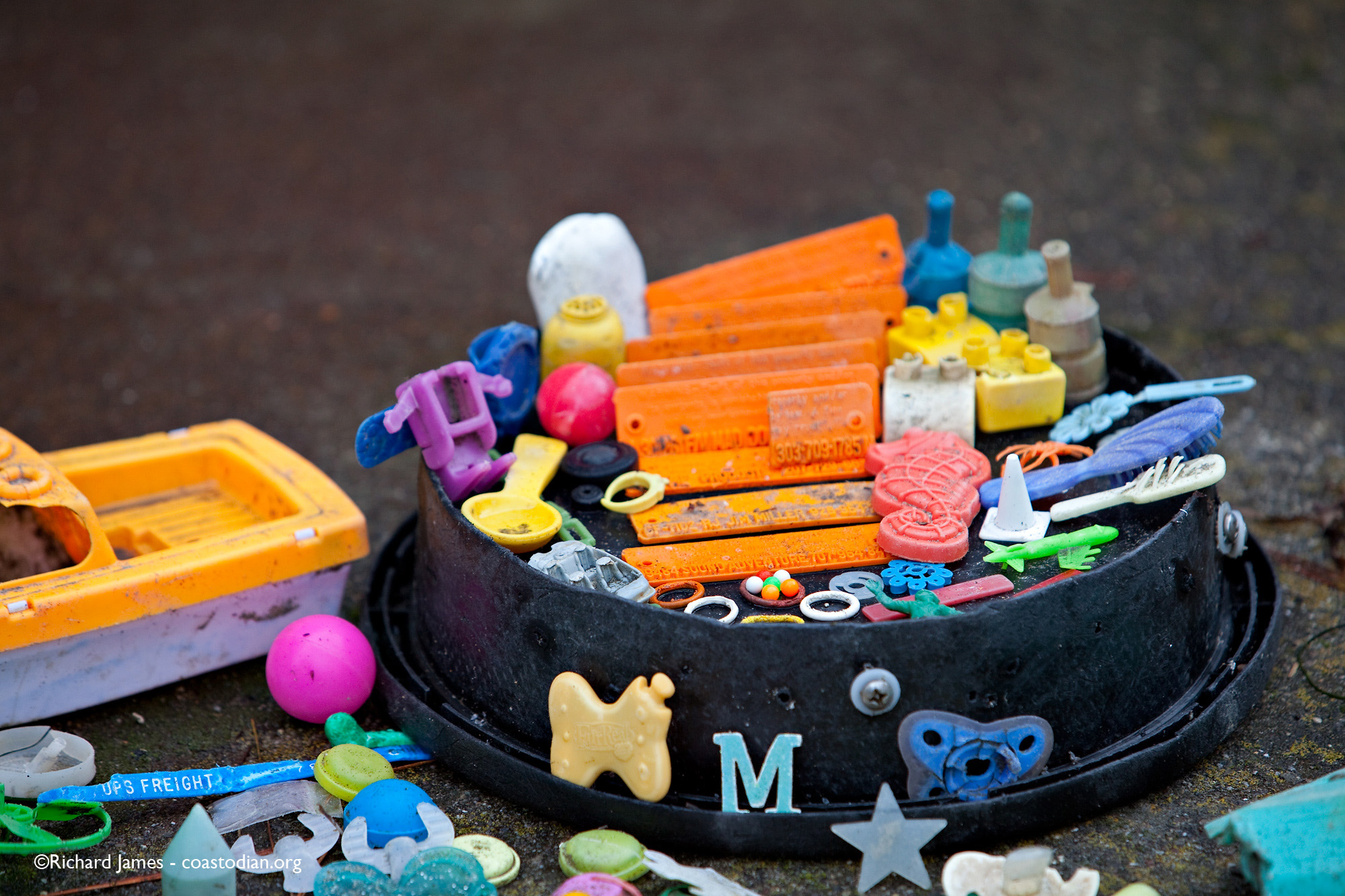
Click on image for bigger picture – Each one of those orange tags represents about $200 in lost gear for a crab fisherman. What if they paid a deposit on each trap set? To offset the cost of picking up after all their gear that litters the ocean and beaches.

Click on image for bigger picture – Black PVC pipe oyster spacers used by Drakes Bay Oyster Company. You see 75 or so here. I have found over 5000 of these on Point Reyes beaches, as well as dozens oyster grow-out bags and the foam from inside grow-out bags.

All forms of commercial fishing take a huge toll on our planet.

Is it asking too much to set aside portions of the planet as areas we tread upon lightly, or tread upon not at all?

Many say we must do all we can to produce food locally, sustainably to feed the 7 billion humans on earth.

Others say we need to slow the growth of the human population, keep it more in line with the carrying capacity of earth.

This planet is fragile. Humans, only one of the many species on this blue sphere, have developed the means to do great good and great harm. As we ever more quickly modify our nest, it is less able to feed an ever growing population. Does this make sense? Does a growing family move into ever smaller and smaller housing?

I think The Dude said it best:

Tired of plastic on the beach

Click on the title of this post to read it and see a related header image.

A dozen or so tires wash up on the beaches each year at Point Reyes. Most of them on the rim which makes them very heavy. I usually move them up as high on the beach as I can in case someone more industrious than myself feels like packing them out. I’ve only packed out two that I can recall. The rest either washed back out, or someone came and got them.

There is a forty-eight inch diameter aircraft tire buried in the sand on Drakes Beach, sans rim. In case you feel inclined to go get it, park your car near the cafe, walk ~2 miles to the right(low tide a must), it is high on the beach. Bring a shovel or two.

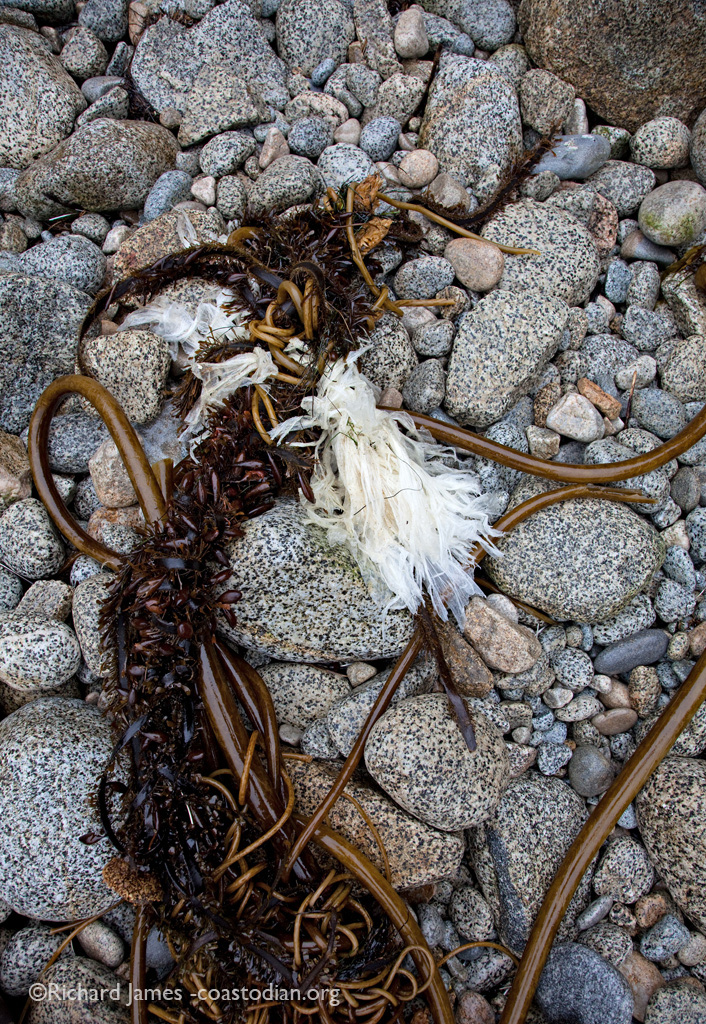
Shredded plastic wrap tangled in bull kelp and feather boa kelp

Bull kelp and feather boa kelp, minus the plastic

Tangled up and blue

Click on the title of this post to read it and see a related header image.

September, seductive winter light is coming on, beaches are covered deep in sand pushed ashore over the summer, making access easier. Not the high season for litter usually. Local fisherman have been plying the Marin coastline for months looking for crab, salmon, halibut and rockfish.

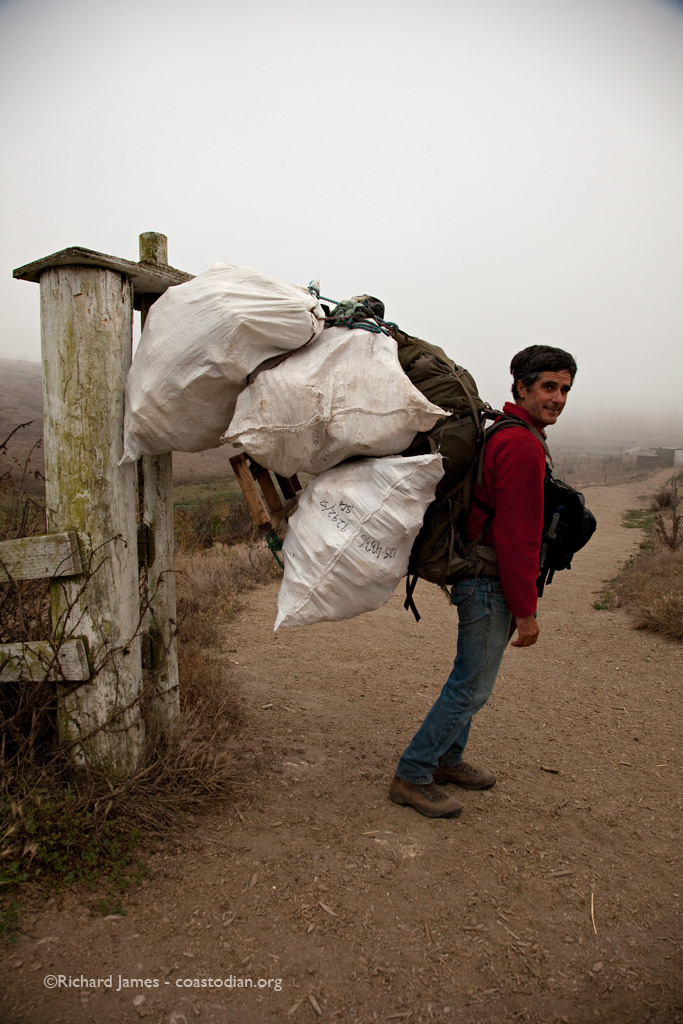
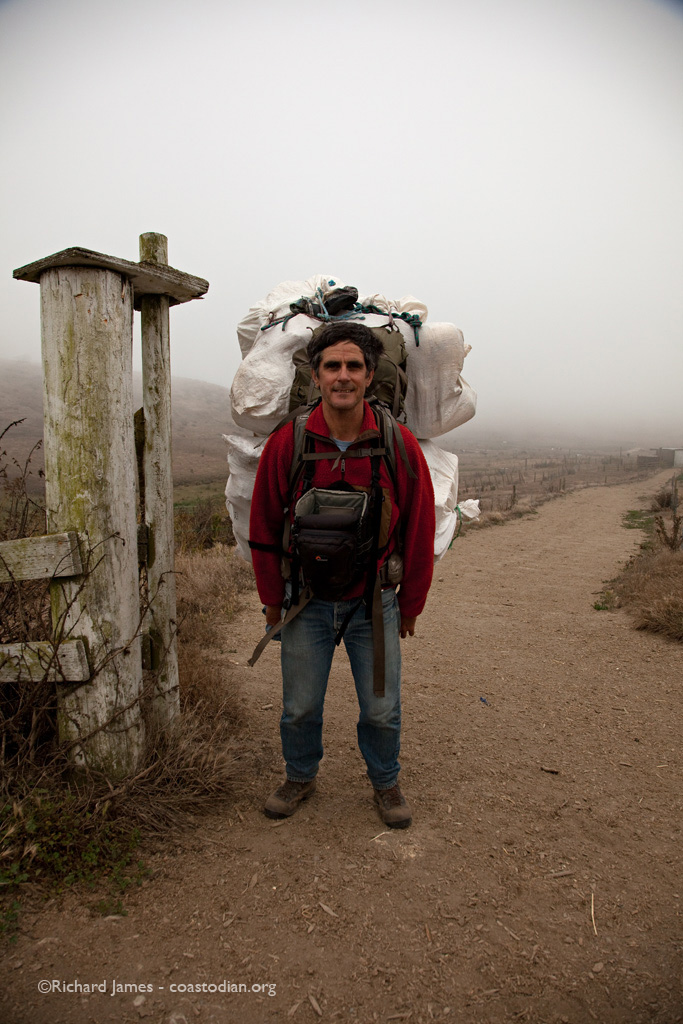
I can tell when they have been out. Beaches are covered in beer and soda cans, bait packaging, miles of plastic rope, hundreds of buoys and bait containers, snack wrappers and sometimes fishing poles or parts of boats. All blown or carelessly tossed overboard, then blown to shore. I pick it all up and pack it out on my back.

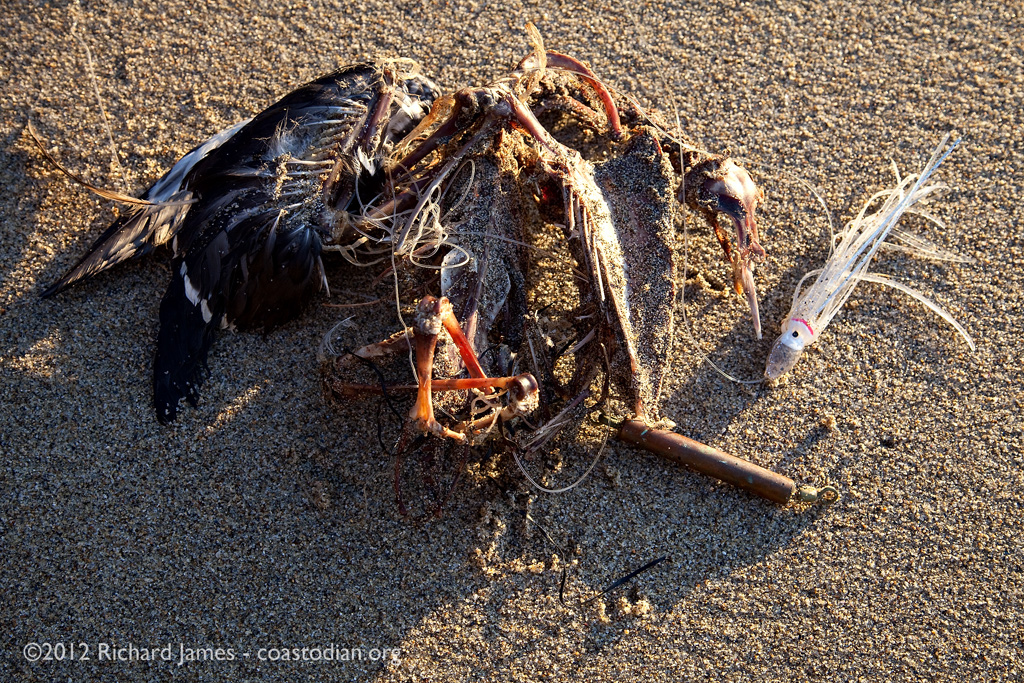
This evening a shiny flasher caught my eye in the wrack, I bent down to untangle it from the surf grass and other kelp. A long strand of mono-filament was threaded into the plants, a plastic hoochie, more line, a copper spring of some sort. Then I spied the scavenged body of a seabird, a murre or guillemot with a large nest of the mono-filament tangled around what was left of the wings and sternum.

NOTE: According to a bird expert I know, the bird is a common murre.

Had the bird seen a fish on the hook, swallowed it and died? Or had it surfaced and become tangled up in the line after diving perhaps 200 feet deep in search of a meal? I did not know. I only know that it was alive before coming into contact with this man-made trash, and now it was dead, wrapped in plastic.

Egg to bird to egg to bird and so on. Nothing in that cycle is toxic. All of it breaks down into something another creature uses for life.

Humans on the other hand have created all manner of clever tools. Tools made of plastic, which comes from oil. Plastic clothing, plastic fishing gear, plastic boats, plastic food wrappers. All of it so convenient for humans, for a moment that is. Once we are done with our “single-use” item, we generally toss it overboard, or into the land-fill, or the street, or out the window as we drive down the freeway.

None of this plastic breaks down or goes away or turns into something humans can eat.

What other creatures celebrate milestones in their life by releasing balloons into the air? Balloons made of nylon or latex that will fall back to earth eventually. Balloons that look like jellyfish and other forms of food to sea-life. Have a look here at the hundreds of images of balloons I found at the beach and in the High Sierra Nevada.

We are poisoning our nest, the nest of all the creatures on this planet, with our human conveniences.

Can we survive without so much plastic in our lives?

We survived until 1907 without any synthetic plastic.

From an article in the New York Times:

About 300 million tons of plastic is produced globally each year. Only about 10 percent of that is recycled. Of the plastic that is simply trashed, an estimated seven million tons ends up in the sea each year.

There, it breaks down into smaller and smaller fragments over the years.

The tinier the pieces, the more easily they are swallowed by marine life. (One study found that fish in the North Pacific ingest as much as 24,000 tons of plastic debris a year).

Mad ocean, foaming at the mouth

Click on the title of this post to read it and see a related header image.

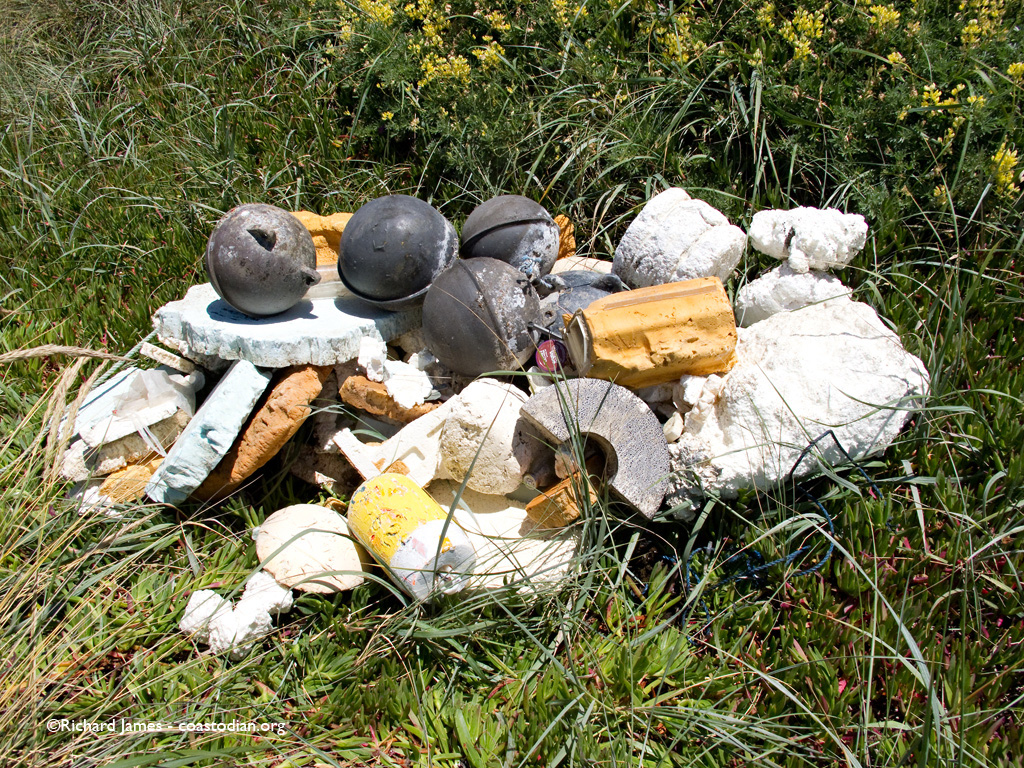
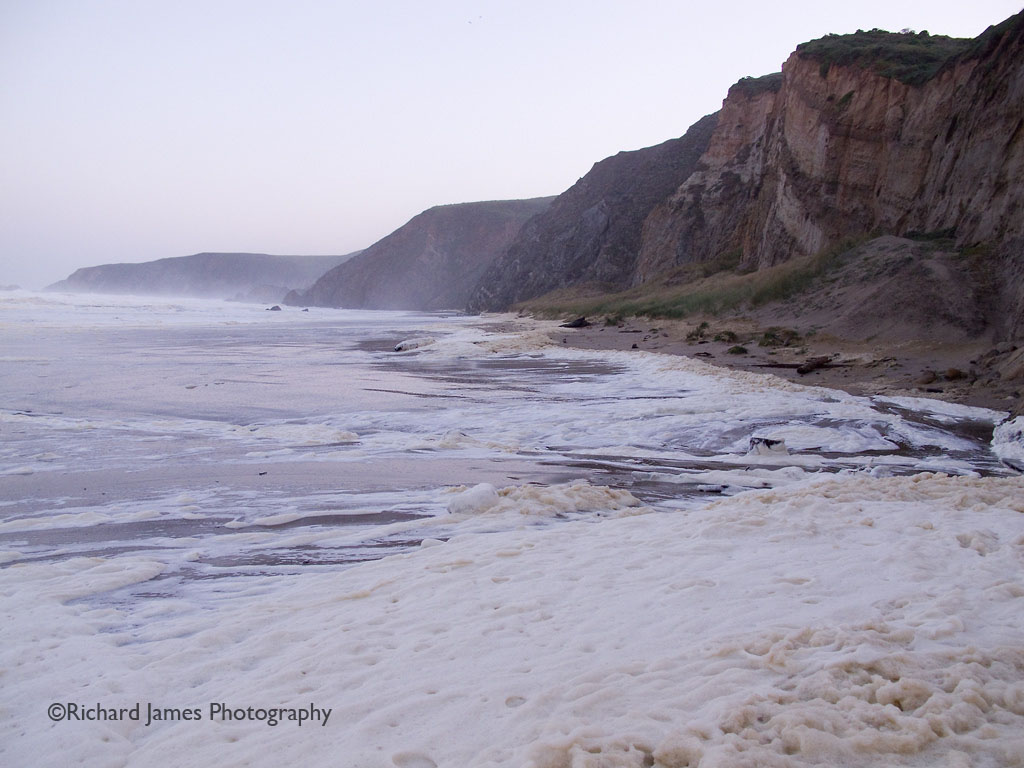
The past few months have brought a never-ending supply of foam to the beaches at Point Reyes. Mostly polystyrene, though other flavors as well, all petroleum based.

This pile has been growing and shrinking for several months. I add to it that which I am unable to haul out at the time, then return later to pack out what I can.

I strive to get foam off the beach as soon as possible. Birds peck at it looking for food, harming themselves in the process, as well as breaking it up into smaller pieces for other unsuspecting animals to attempt to snack on.

This young elephant seal is still trying to figure out how to feed itself now that mom and her high-fat milk is gone. I hope it quickly learned that foam is NOT food.

The rough water of winter storms grinds it up and pushes it into the drainages that meet the beach.

Such a lovely sight in a national seashore!

This scene is reproduced all over the world each and every winter.

I spent nearly 2 hours picking up most everything not wood or sand in this image.

Foam does not weigh much, but it is big and bulky. Forty-five pounds or so on one’s back is like a spinnaker. Thankfully I had the wind at my back on the hike out and made great time.

The next stop for this load of man-made mess is the dumpster at Point Reyes headquarters.

I wonder where the contents of the dumpster will end up?

Remember, on this tiny planet, there is no away.

A long walk on The Great Ocean Beach – Point Reyes

I’ve not posted anything in a while.

My creative muse is on extended hiatus and my writing is not something I am overly fond of.

Last night the swell off Point Reyes was over 20 feet for an extended period of time, peaking at nearly 25 feet around 3:00 am. Big waves! Big fun.

I love being on the beach when the energy is high.

Last year I walked nearly the entire Great Ocean Beach with a few friends. We got a late start and grew tired, so we did not do the last mile.

Yesterday I decided to bag the whole enchilada. I packed food and drink, and all the clothes I might need. Without a car shuttle, I either needed to hitch a ride at the other end or do the walk twice. How would my legs hold out?

The blue line is my track - click to see a larger image

Got up at 5:00 am, drove to North Beach (the midpoint of the Great Ocean Beach, some call it ten mile beach, others twelve mile beach, I call it the outside beach, Drake/Limantour being inside) and stashed two liters of water. Then I drove up to Kehoe Beach and left the car at 6:19 am. After the short walk to the beach I was greeted with moderate winds and huge seas. The foam was deep and all the way up to the dune grass. Enormous waves crashed and pounded the beach.

To do the whole beach proper, I hiked north about two thirds of a mile to the wall. I had to dodge waves and deep drifts of thick foam all the way to the wall. Sea birds, wounded in the heavy surf littered the beach or swam in the foam/water, clearly not well. At the wall I set a waypoint and set off to the wall at the other end by the Lighthouse. It was 6:49 am.

All along the way I was serenaded with the sound and sight of enormous crashing waves. Waves twenty feet high crash long and loud, foamy spray shooting into the sky. The litter load was not as heavy as I would have thought. Lots of crab gear, some pelagic litter (from far away, coated with goose-necked barnacles and green slime) and the usual wrappers, bottles and broken patio furniture. One glass IV bottle showed up with Asian writing. As did a small brown glass vial for needle use. Only one hypodermic needle today.

Given my need for speed, I did not pick up everything in sight as is my usual MO. Plastic bottles, tennis balls, oyster spacer tubes, plastic brims from sports caps and the random toy made it into my several bags.

At one point I almost tripped over a Western Grebe. It immediately began kicking with one leg and crying out. The other leg was lifeless. I backed off a bit til it quieted down and watched it for a few minutes. It was terrified, unable to move except in a semi-circle as it kicked with one leg and cried. I pulled out my knife, said a short prayer, looked it in the eye and put it down.

Still miles from the other wall, I moved out, the lifeless, yet I hoped no longer suffering grebe foremost in my mind.

As I neared the North Beach parking lot, I noticed the heavy surf had knocked down a large portion of the rope fence put up to keep people out of Western Snowy Plover nesting areas. Walking along and resetting several posts, I hoped I had set it in the same location it was before.

By now I had about 35-40 pounds of trash with me, time to cache this and get some water and snack. One apple, some cheese and chocolate washed down with a liter of water and I was good to go.

Eventually I reached the South Wall at 1:07 pm and stopped for lunch. Legs sore and now facing a headwind, the idea of punting at either South Beach or North Beach on the way back crept into my fatigued mind. My third apple, 2 more ounces of cheese and some chocolate consumed, I set off into the quartering-headwind from whence I came.

By the time I reached North Beach again, my legs and feet held the floor and the vote was in, punt. Climbing over the bank, the parking lot was full of cars, surely one was headed to Kehoe eventually.

The nearest car’s driver had just hopped in and turned the key. I caught his eye and got him to roll his window down. “Hi, are you by chance headed to Kehoe Beach?” I asked.

“Well, I am making it up as I go today, where is Kehoe?”

“About twenty minutes north of here, I’ll show you the way and explain the sights as we go.”

“Great, hop on in.”

Daniel was visiting from the East Bay for the day, exploring beaches he had not visited in many years. He drove me right to my car. I and my feet thanked him profusely and we parted ways.

I popped three more ibuprofen and headed back to pickup the trash I had cached at both North and South beaches. I still have another cache to pickup further south and will do that later.

After 20.85 miles in soft, sloping sand, the hot shower felt wonderful.

Stinson Beach Library – Found Art

Four artists’ work is on display at the Stinson Beach Library until 31 January, 2012.

Richard James has two of his large meta-bottles on the patio along with 49 jellyfish I made out of Korean fishing-net floats and crab-fishing rope.

Lina Jane Prairie has baskets made from kelp and the same rope I use for tentacles.

John Norton is showing a few of his collections of similar items found on the beach.

Tess Felix has created two mermaids and a few portraits, mosaics actually, all from the bits of petroleum-based plastic we humans discard every minute of every day which wash ashore on the world’s beaches and are eaten by birds and fish the world over every minute of every day.

Nineteen is a prime number – too large and too small…

Last Saturday I walked 3 miles along Point Reyes Beach from North Beach to Abbotts Lagoon with the Point Reyes Plover expert. She does this regularly during Western Snowy Plover breeding season. She also covers other regions of the Point Reyes Snowy Plover breeding area. This day we were on the lookout for 5 Snowy Plover chicks that had hatched recently.

She prowled for birds while I gleaned the plastics that wash ashore on a regular basis.

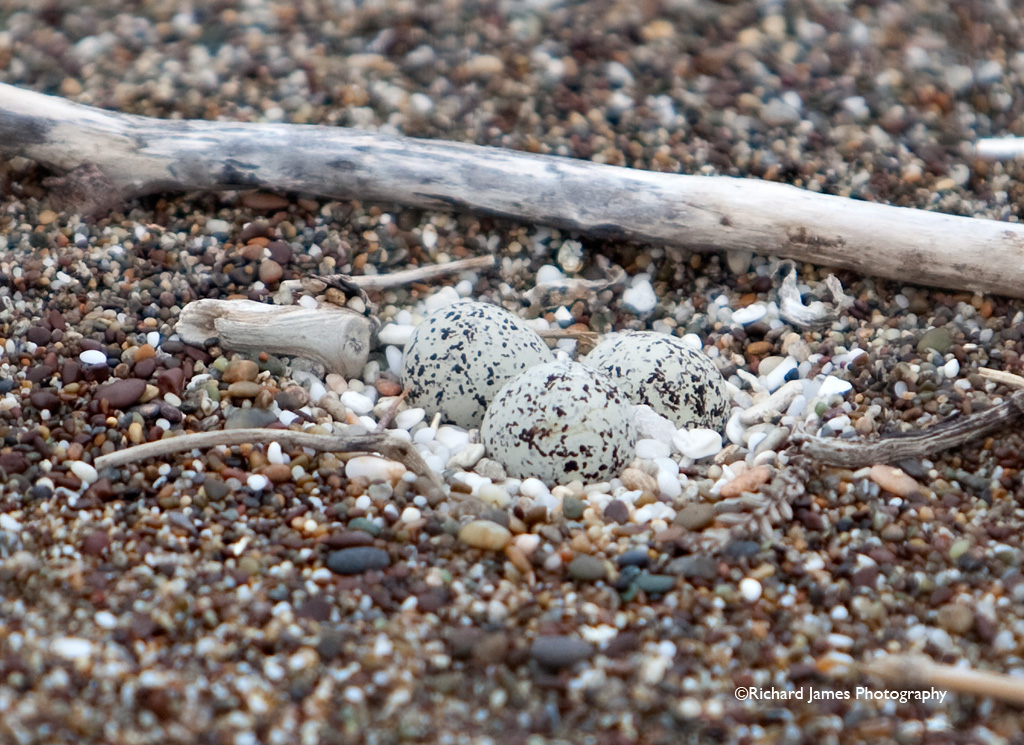
After creating a small depression in the sand and lining it with mostly light colored rocks to increase the stealthiness of the nest, a female plover will lay 2-4 eggs directly on the sand. Most times she lays 3 eggs.

Three Western Snowy Plover eggs in a scrape (nest)

About 28 days later, if the sea has not washed away the eggs, ravens, crows, coyotes, raccoons, skunks or weasels have not eaten the eggs, off-leash dogs or errant humans have not trampled the nest, the birds emerge form their cocoon. Plover chicks are “precocious”, meaning that they are out of the nest and cruising for food within hours after hatching.

Mother plover leaves to go find another mate, father plover begins a month-long odyssey attempting to ensure his brood learns to eat, and keeps from being eaten.

Researchers consider a chick fledged if it survives 28 days. The last 3 years at Point Reyes have seen 7, 8 and 5 chicks fledge (2010, 2009, 2008). There are an estimated 5000 plovers, period.

Western Snowy Plovers are on the endangered species list. This means that they are in danger of going extinct. Extinct means there are no more plovers. Ever.

Dog owners, please keep this in mind the next time you want to let your domesticated, far from extinct pal run off-leash in this area.

Beach driftwood architects, enjoy building your complex driftwood structures. But, once you are done, please dismantle your work-of-art. Ravens use these structures to rest and look for prey, including endangered plovers. Don’t make it easy for ravens to further reduce the dwindling numbers of snowy plovers.

The park plover expert knows when each plover egg is laid and when each chick hatches. Finding all plovers present and accounted for each day is a good day.

Last Saturday we found all 5 chicks, plus fourteen adults for a total of nineteen birds.

I found a small bag of plastic trash, including nineteen plastic beverage bottles.

Nineteen plastic bottles, nineteen too many

So, depending on one’s perspective, nineteen is too small, and too large.

Please use one metal bottle for your drinking water needs.

The coastodian

Powered by petroleum

Click on the title of this post to read it and see a related header image.

Powered by petroleum

Does my Prius consume more gasoline to go a mile than was needed to build and ship all those plastic bottles on the roof?

I don’t know.

Google could give me lots of numbers in a short time.

My eyes tell me that plastic bottles, even one, consume too much oil.

We kid ourselves, thinking it gets recycled, all is good.

If it gets recycled, why do I find thousands upon thousands of plastic water bottles on a fraction of the California coast each year?

What about all the animals that will eventually eat all that plastic we keep dumping in the ocean?

Man is one of those animals.

Tomorrow, instead of pouring milk on your cereal or in your coffee, eat the bottle.

Go direct!

Cut out the middleman and save.

Experience what all the fishes and birds in the sea do every day.

Or buy milk in a glass bottle.

Or raise chickens and trade their eggs for milk from your neighbor’s cow Rosie like a friend of mine does.

That bottle on my car is at Marin Arts Council for another month as part of their Pop Art show.

Check out the show here.

Go see lots of cool art. Buy a card and support the arts and your local coastodian.

Stop buying bottled water!

Get a metal water bottle and use your tap.

Put a filter on the tap if you don’t like the taste.

Stop fouling the rivers if you don’t want to filter that which belongs to our children, and their children, and so on.

the coastodian

I don’t like your bottles in the park

Click on the title of this post to read it and see a related header image.

A couple days ago I stopped to get coffee at a local market.

As I got out of my car and walked towards the door, cup in hand, a woman I know shouted out to me “Hey, shouldn’t you be out on the beach picking up trash?”

She was smiling as she said it. One of those smiles that says I am kidding, but not fully.

I explained that I wrenched my knee and was on the DL for a while as I recuperated.

Standing feet apart from one another at the edge of Sir Francis Drake Boulevard, she said to me, “I saw your sculptures in the park by the visitor center. I don’t like them in the National Park.”

I’ve known her for a few years now, mostly bumping into her at volunteer events at the park. She is a long time Point Reyes National Seashore volunteer, roosting in West Marin when not at one of her other residences.

She is always pretty direct, in your face. She likes to get a reaction with her words.

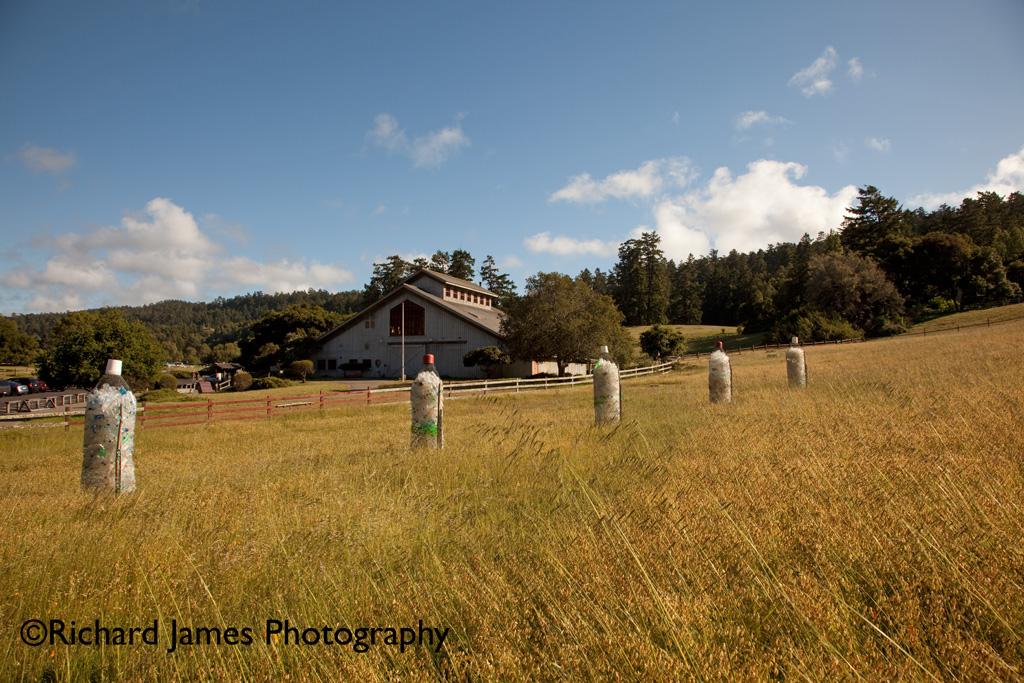
The object of her disdain is “Thirsty?”, my collection of five eight-and-a-half-foot-tall plastic bottle sculptures. I spent a year picking up about a ton of trash off park beaches, from which I culled one item, plastic bottles, to create the art installation.

“What don’t you like about the sculptures?” I asked.

“I don’t like their aesthetic,” she said.

“Yeah. They look kind of trashy in the meadow don’t they?” I stated.

“That’s right, I don’t like that sort of thing in the National Park, it looks bad,” she said.

At this point I am figuring she declined to walk over to the art installation and read the 43-word interpretive panel explaining the piece.

“I’m glad you don’t like it,” I said, “neither do I. All that trash in the park is just plain wrong!”

I encouraged her, after entering the market, to ask the owner to stop selling bottled water. He has told me he is a capitalist and he intends to make money, consequences be damned.

I’m not quite sure she got the message of “Thirsty?”.

Tons of trash washes ashore on California beaches each and every day. Most of it almost tinier than the eye can see in the form of (raw plastic-nurdles), shredded Styrofoam pellets, packaging, toys, fishing gear, food containers etc.

Most people don’t see the magnitude of the trash problem when they visit the beach.

Magnifying the problem by building eight and a half foot tall plastic bottles apparently registered on her radar.

How big do I need to make these bottles to get on a majority of people’s radar?

We are shitting in our nest a toxic brew of chemicals nature cannot metabolize.

Please, use one metal bottle!

the coastodian

Thirsty? at Bear Valley Visitor Center - Point Reyes National Seashore